Master Your VO2max : How To Measure VO2max And Beat Fatigue
Your heart is the engine of your body, and your lungs are the parts that supply air and act as its exhaust, allowing it to work as it should. Together, they keep your body — the ultimate machine known to man — working. A problem with one means that the other is in danger.
VO₂ max is the measure of the fitness of both these organs. Citing another metaphor, your VO₂ max levels are akin to your body’s horsepower.
People in the know measure VO₂ max to understand how much power these two can generate, especially when they push their bodies to the limit in intense workouts and other intense activities. This blog is your learning material, so that you can also be like these people, who have achieved peak cardiovascular fitness by mastering this power.
The “V” in VO₂ Max stands for “Volume”, and the “O₂” represents “Oxygen”, the primary gas that the body needs to stay alive, which it can only get through breathing.
What this tells you is that this metric represents a measure of a human being’s aerobic capacity (the body’s ability to put oxygen to use for different purposes during physical activity).
Have you ever seen someone so out of breath after climbing a flight of stairs? Or have you seen how friends collapse, gasping for air, after a small game of tag with their children? The people in these scenarios have very poor aerobic capacity and are in real danger.
Many things can be done to improve this, but when you measure VO₂ max, you get a sense of direction. That way, you don’t just try every fix that your favourite influencer sells to you as a way to improve your cardiorespiratory fitness; you’ll be more deliberate in the steps you take towards achieving peak lung and heart function.
Studies show that if a person’s VO₂ max numbers are high, it means that the person is less prone to many diseases and will live a longer life.
People think they are at peak fitness because they can work for long hours and can lift a few heavy weights. Many times, this is not the case. If you want to know how fit you really are, take a VO₂ max test.
To put it into perspective: a high VO₂ max is the difference between the sprinter who completes a race and can still stand upright to greet his competitors and the audience, and the one who falls to the ground immediately.
Both sprinters are among the fittest humans in the world, each with a very high fitness level, but one is fitter than the other because his lungs and heart are at peak fitness levels. They process oxygen at better rates than the other one, who had to go down to catch their breath before doing the post-sprint greeting rounds.
Here’s a real-life example for more context:
Sports health data collected just before the 2016 Olympics recorded the top VO₂ max as 85 ml/kg/min (for Great Britain cyclist Chris Froome). In contrast, professional football players at the peak of their sport, who run back and forth for 90 minutes of a football match, typically test around 64–66.
Froome may not be able to run back and forth like the likes of Tim Cahill did in his time, but the man is scientifically and medically fitter than anybody playing football at the highest level, and with a better aerobic capacity than them, too.
In practical terms, Froome can do anything harder and longer than footballers before he gets tired, and that probably includes football!
In summary, you should measure and master your VO₂ max because:
VO₂ max is measured using an exercise test in a lab, medically referred to as a cardiopulmonary exercise test (CPET) or maximal exercise tests.
The subject is hooked to a machine that measures their lung and heart capabilities. They also wear a breathing mask and are made to run on a treadmill or work out on an exercise bicycle. The speed and intensity of the exercise are increased slowly, and the machine – a metabolic cart – measures the subject’s oxygen consumption and their carbon dioxide exhalation. The incremental exercise test continues until the subject has fully exerted themselves and is basically out of breath.
The difference between the oxygen the subject breathes in and the oxygen they breathe out while doing the test is recorded as the subject’s VO₂ max numbers, showing how strong their cardiovascular system is. The unit of this measurement is expressed in millilitres of oxygen consumed per minute per kilogram of body weight (mL/kg/min).
At Longevity Clinics, once you complete the test, you’ll get your numbers and some personal data to guide your overall health journey. In this packet, you’ll see your heart rate zones and thresholds–basically a map of your physiological strengths and weaknesses. It is this data that will be used to prepare a training programme and determine training zones for you to optimise your cardiovascular functions.
The steps below outline each step of a VO₂ max test, to provide a clearer picture:
You run on the treadmill or cycle with the breathing mask on. Every 2-3 minutes, the doctors increase the speed and intensity of your exercise.
The mask you wear is connected to a metabolic cart that records how you breathe in and out. Tracking the latter (carbon dioxide exhalation) is important because you tend to exhale more when you hit your physical limit, which is why people pant and gasp for air after being in strenuous situations. Medically, this is called the “lactate threshold”.
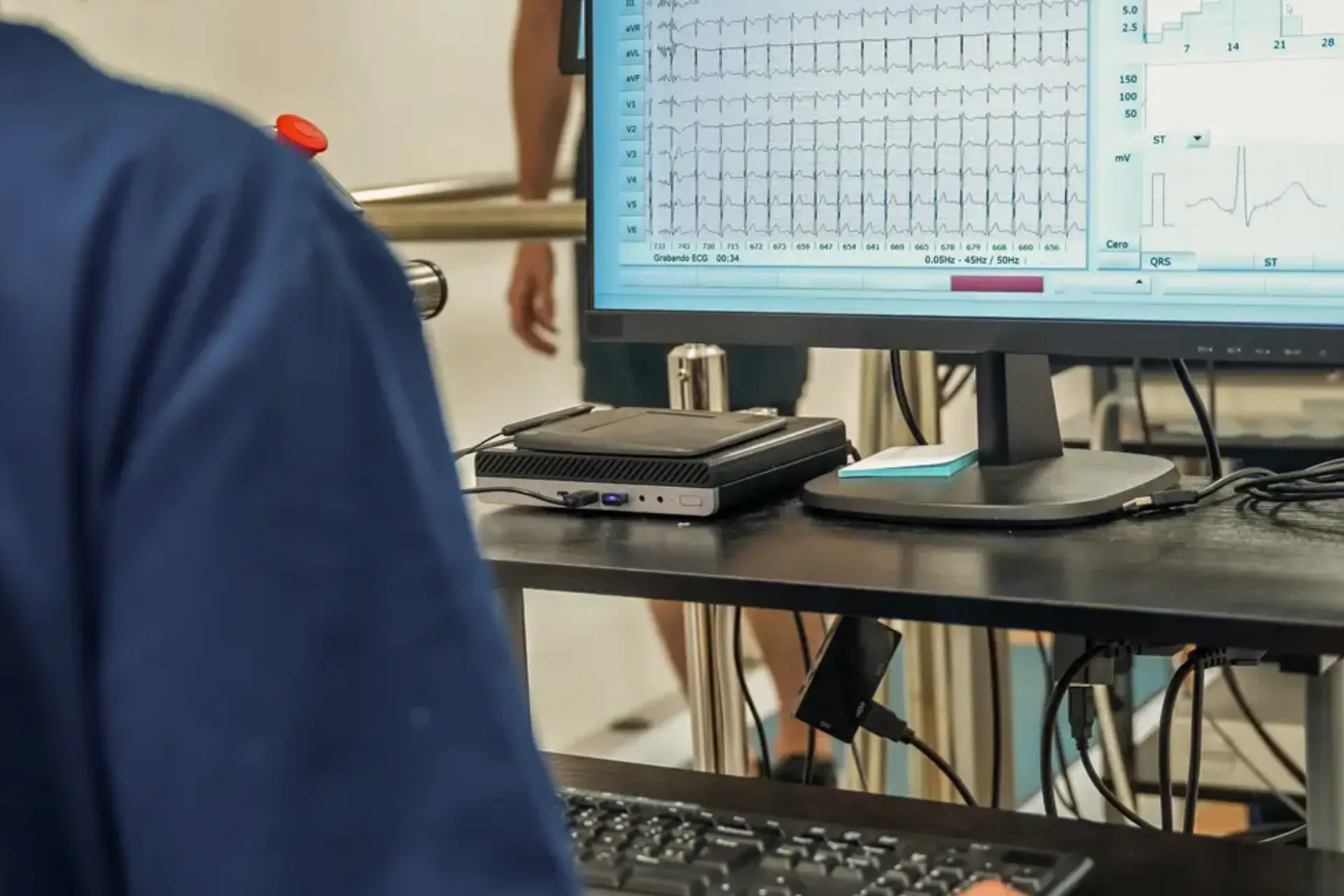
You will also be wearing a chest-strap heart rate monitor and/or ECG leads to check how your heart is doing. The machine records your heart rate closely, too.
The incremental exercise test can go on for hours, depending on how fit your cardiovascular system is. Once your muscles officially give up, the test ends. Typically, the test lasts no longer than 20 minutes, but there might be someone out there who can shock the world!
All this while, the machine will be taking note of your breathing patterns and monitoring your heart rate. It records every oxygen uptake that happens as a result of your heart and lungs working as they should, together, during the exercise. The highest uptake observed at the end of the test is your VO₂ max.
By virtue of this being a test, you can prepare for it, too. Before the test, however, the clinicians will check your overall health. This includes tests to see your heart rhythm and blood pressure, and some minor checks. Once you’re cleared, you’ll be hooked to the machine to start your test. If anything happens during the test, like dizziness, chest pain, etc., they will stop the test immediately.
One key reason why you should take preparation for a cardiopulmonary exercise test seriously is that you will be able to learn the upper limits of your own body. Going to the test without preparation will only lead the machine to reveal your body’s limits at the time, instead of its true limits.
Here’s how to prepare for your test:
If anything happens to stop your test, like dizziness or chest pain, you can repeat the same preparatory steps before you retake the test. If you also want to take it again after working on your cardiovascular fitness following the results of your last one, repeat the same preparatory steps before the test as well.
Most importantly, don’t wear clothes that will be difficult to take off, as you will have to take them off to be hooked to the machine.
If you live a regular, healthy life with a day job, a family, and hobbies that don’t require intense activity, measuring and mastering your VO₂ max can greatly improve the quality of your life, even though it can feel like taking performance enhancements.
Typically, sportspeople – especially endurance athletes – and fitness junkies measure VO₂ max and take it seriously. The numbers from your test can help you learn your fitness level and aerobic capacity. That’s why mostly endurance athletes and sportspeople who are active for long periods (sports seasons) before taking a break, take it seriously.
The figures help to design training programmes that improve a person’s cardiac output and physiological strengths. That way, a person can use their body to the max without fear of injury or a shutdown.
It also helps to create programmes within a person’s limits for the same reasons. With your VO₂ data, your trainer can help you break down your exercise intensity into specific heart rate zones that are perfect for your body:
When you master your VO₂ max, you will find everyday things like climbing stairs, taking walks, and so on, which you used to steel yourself to do, a lot easier. You will also lower your risk of getting cancer, diabetes, stroke, and heart disease.
When you measure VO₂ max, you get a clear picture of your fitness level and oxygen uptake.
Lab tests are the most foolproof way to get accurate results, but you can get a rough idea by using modern fitness trackers and heart rate monitors when you exercise or do any intense activity.
If you want precise results using a fitness tracker or a heart-rate monitor, do an incremental exercise test on a treadmill or on a stationary exercise bike. Also, do balance exercises that feature the right amount of high-intensity workouts, aerobic workouts, strength workouts, mobility workouts, and recovery exercises.
VO₂ max is the measure of your oxygen uptake, but it is more than a number. It is a roadmap to perfect health.

We’ve developed a comprehensive six-step process that acts as your personal health roadmap, to follow towards your health goals.


