


VO₂max is one of the most established measures of cardiorespiratory fitness. It describes the maximum amount of oxygen your body can take in, transport and use during intense exercise. Because oxygen delivery involves several systems working together, VO₂max can provide useful information about aerobic capacity and exercise performance.
It is important, however, not to treat VO₂max as a complete measure of health. Your result is influenced by your cardiovascular system, lungs, muscles, training status, age, body composition and other factors. A VO₂max test can provide valuable information about exercise capacity, but it does not by itself diagnose the cause of fatigue or determine whether someone is generally “healthy”.
What Is VO₂max?
The term VO₂max refers to maximal oxygen uptake:
- V refers to volume.
- O₂ refers to oxygen.
- Max refers to the highest oxygen uptake reached during a sufficiently intense exercise test.
Oxygen is taken into the lungs, transferred into the bloodstream and delivered to working muscles. The cardiovascular and respiratory systems therefore play important roles in aerobic exercise, while the muscles themselves also determine how effectively oxygen can be used.
VO₂max is usually expressed as millilitres of oxygen consumed per kilogram of body weight per minute (mL/kg/min).
A higher VO₂max generally indicates a greater capacity for sustained aerobic exercise, although there is no single VO₂max value that defines “good health” for everyone. Age, sex, genetics, training history and the type of activity performed all influence the result.
Why Measure VO₂max?
Cardiorespiratory fitness is associated with important health outcomes. Large bodies of research have found that lower levels of cardiorespiratory fitness are associated with higher risks of cardiovascular disease and premature death. This makes fitness assessment potentially useful as part of a broader picture of health. It does not mean, however, that a particular VO₂max score guarantees protection from disease. Research summarised by the American Heart Association describes cardiorespiratory fitness as an important marker associated with cardiovascular and mortality risk.
Measuring VO₂max can also help provide a baseline for exercise planning. If the measurement is repeated under comparable conditions, changes in aerobic capacity can be assessed over time.
For someone experiencing unexplained exercise intolerance, shortness of breath or reduced exercise capacity, cardiopulmonary exercise testing may provide additional information about how the cardiovascular, respiratory and metabolic systems respond to exercise. CPET can help clinicians investigate possible causes of exercise limitation rather than simply assigning a fitness score.
It is also worth remembering that VO₂max is only one part of physical fitness. Strength, muscular endurance, mobility, balance, recovery, sleep and everyday physical activity all contribute to health and physical function.
How Is VO₂max Measured?
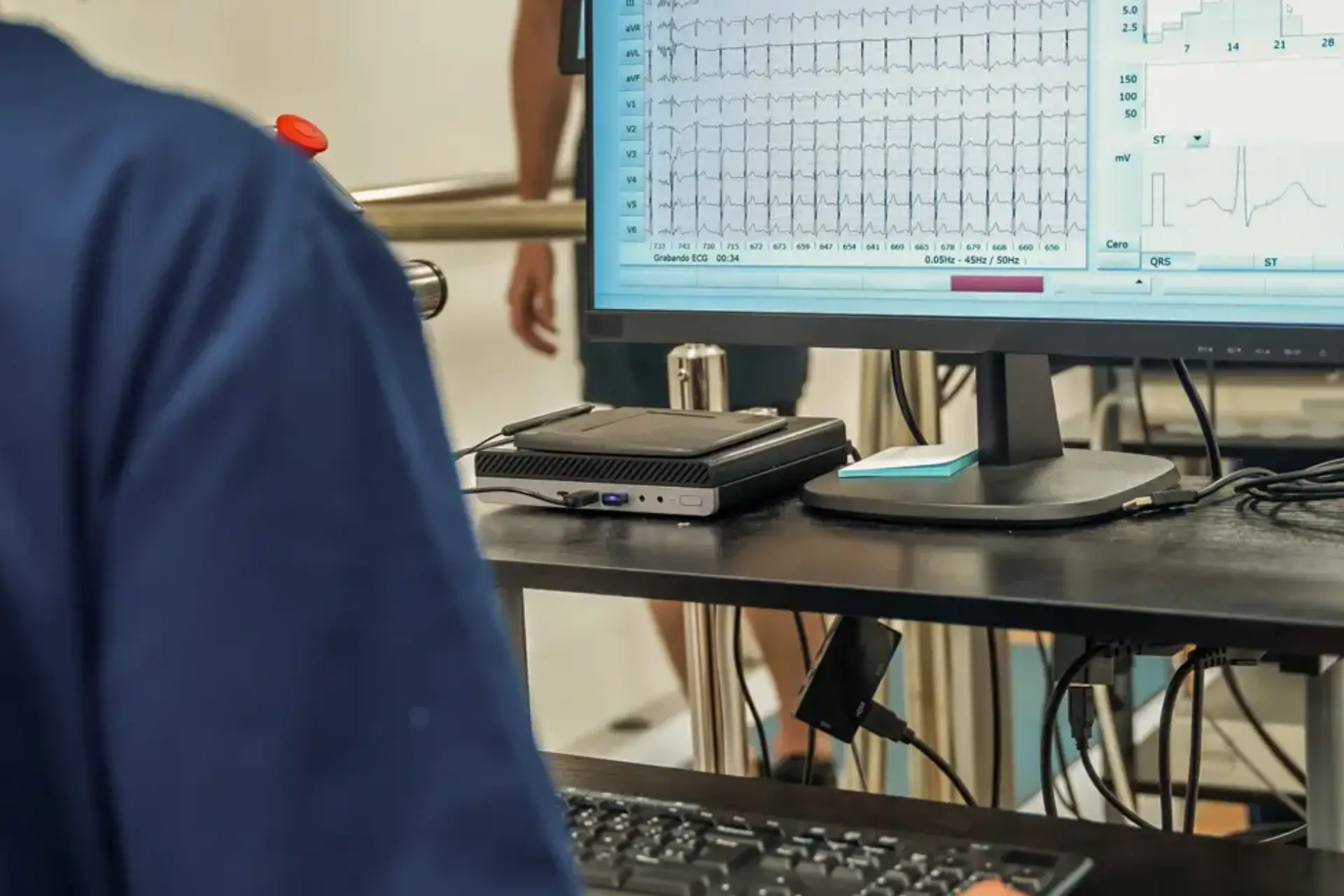
The most direct assessment of VO₂max or peak oxygen uptake is performed during an incremental exercise test, commonly using a treadmill or stationary cycle. In a cardiopulmonary exercise test (CPET), exercise intensity is gradually increased while breathing gases and cardiovascular responses are measured.
The person normally wears a breathing mask connected to a metabolic measurement system. The equipment measures variables including:
- oxygen consumption (VO₂)
- carbon dioxide production (VCO₂)
- ventilation
- heart rate
- workload or exercise intensity
Depending on the clinical setting and protocol, other measurements may also be collected, such as blood pressure, oxygen saturation and ECG information.
CPET is widely regarded as a gold-standard method for assessing cardiorespiratory functional capacity because it evaluates the body’s response to exercise across multiple systems at the same time.
The highest oxygen uptake reached during the test is reported as VO₂max when accepted criteria for maximal oxygen uptake are met. If those criteria are not met, the result may instead be described as peak VO₂.
What Happens During a VO₂max Test?
The exact protocol varies according to the equipment, purpose of the assessment and individual circumstances, but a typical incremental test follows several stages.
1. Initial assessment
Before a maximal exercise test, the supervising clinician should consider relevant medical history, symptoms, medications, cardiovascular risk factors and the person’s ability to exercise safely. Baseline measurements may include heart rate and blood pressure, with ECG monitoring used when clinically indicated or included in the testing protocol.
2. Exercise begins at a manageable intensity
The person exercises on a treadmill or cycle ergometer while wearing a breathing mask or mouthpiece connected to the metabolic measurement equipment.
3. Exercise intensity gradually increases
The workload is increased according to the selected test protocol. As the intensity rises, oxygen consumption, carbon dioxide production, ventilation and cardiovascular responses are monitored.
4. Physiological thresholds may be assessed
CPET can provide information about physiological thresholds, including ventilatory or gas-exchange thresholds. These measurements should not be confused with simply “exhaling more carbon dioxide”. They are determined from changes in breathing and gas-exchange variables during progressively harder exercise.
5. The test ends when appropriate
The test may continue until the intended level of exertion is reached, the person reaches a physiological endpoint, or symptoms or other safety considerations require the test to stop. A maximal exercise test is not something that should be continued regardless of symptoms.
6. The results are interpreted
The clinician reviews the VO₂ response together with heart rate, workload, ventilation, gas exchange and other available measurements. This broader interpretation can provide more useful information than looking at the VO₂max number alone.
Can VO₂max Help Explain Fatigue?
Fatigue has many possible causes. Poor aerobic fitness can contribute to reduced exercise tolerance, but fatigue is not synonymous with a low VO₂max.
Persistent or unexplained fatigue may be related to factors such as insufficient sleep, excessive training, inadequate nutrition, stress, medication effects or an underlying medical condition. Depending on the symptoms, a healthcare professional may need to consider a broader assessment rather than relying on a fitness test alone.
CPET can sometimes help identify whether exercise limitation appears to involve cardiovascular, respiratory, metabolic or conditioning-related factors. However, the test should be interpreted in the context of the person’s symptoms, medical history and other clinical findings.
This distinction is particularly important for anyone experiencing new, unexplained or worsening fatigue, chest discomfort, unusual breathlessness, dizziness or reduced exercise tolerance. These symptoms should not simply be attributed to being “unfit”.
Preparing for a VO₂max Test
Preparation instructions vary between testing facilities and protocols. Follow the specific instructions provided by the clinician or exercise-testing laboratory rather than applying a generic preparation plan.
Depending on the protocol, you may be advised to:
- avoid unusually strenuous exercise before the assessment
- maintain normal hydration
- get adequate sleep
- avoid eating a large meal shortly before testing
- wear comfortable exercise clothing and suitable footwear
- tell the supervising clinician about relevant medications, symptoms or medical conditions
- follow any specific instructions concerning caffeine, alcohol or medications provided by the testing service.
There is no universal requirement for everyone to avoid caffeine for an entire day before a VO₂max test, and fasting requirements can vary. The purpose is to obtain a safe and interpretable assessment under standardised conditions rather than to create an artificial “perfect” physiological state.
If you are taking medication that can affect heart rate or exercise performance, do not stop it unless instructed to do so by your treating clinician or the testing team.
Understanding Your VO₂max Result
VO₂max is normally reported in mL/kg/min. The number should be interpreted against relevant reference values and, importantly, in the context of the person being tested.
For example, two people with the same VO₂max may have different exercise goals, medical histories and training requirements. Likewise, comparing a highly trained endurance athlete with a recreational exerciser does not provide a clinically meaningful judgement of one person’s overall health against the other.
For athletes and physically active people, a VO₂max result may be useful alongside training history, performance measures and physiological thresholds. For people undergoing clinical assessment, the wider CPET profile may be more informative than VO₂max alone.
What About Heart Rate Training Zones?
Heart-rate zones can be useful for structuring exercise, but they should not be presented as universal percentages that apply identically to everyone.
Common training systems divide exercise intensity into several zones, ranging from easier recovery or low-intensity work through to vigorous and near-maximal exercise. The exact number of zones and the method used to determine them vary between training systems.
Where testing data are available, exercise intensity can be prescribed using information such as measured heart-rate responses, workload and physiological thresholds. However, heart rate is affected by factors including temperature, hydration, stress, sleep, medication and training status.
A VO₂max test can therefore contribute useful information to exercise programming, but it should not be interpreted as automatically producing a single “perfect” training zone for every session.
How Can You Improve Cardiorespiratory Fitness?
Cardiorespiratory fitness can respond to regular physical activity and structured training. The most appropriate programme depends on a person’s current fitness, goals, health status, experience and ability to recover.
For Australian adults, national physical activity guidance recommends being active on most days, including moderate- to vigorous-intensity activity, muscle-strengthening activity on at least two days per week, functional activities targeting mobility, balance and coordination, and reducing prolonged sedentary behaviour.
For someone starting from a low level of fitness, gradually increasing activity may be more appropriate than immediately attempting high-intensity exercise. For trained individuals, a structured programme may include a mixture of lower-intensity aerobic work, higher-intensity intervals, strength training and recovery.
The goal should not simply be to chase a higher number. Improvements in exercise tolerance, strength, functional capacity and the ability to perform everyday activities may also be meaningful outcomes.
VO₂max Tests and Fitness Trackers: What Is the Difference?
Many smartwatches and fitness trackers provide an estimated VO₂max value. These estimates can be useful for monitoring trends, but they are not equivalent to directly measuring oxygen consumption during a laboratory exercise test.
Wearable devices generally use combinations of information such as heart rate, movement, pace and personal characteristics to estimate aerobic fitness. Different algorithms and devices can produce different estimates.
Research has found that estimated VO₂max values can differ from directly measured values, particularly when prediction equations or indirect methods are used.
If an accurate physiological assessment is important, direct measurement during a properly conducted CPET provides a more comprehensive approach than relying solely on a wearable estimate.
What a VO₂max Test Can — and Cannot — Tell You
A VO₂max assessment can provide useful information about:
- aerobic and cardiorespiratory fitness
- exercise capacity
- the body’s response to increasing exercise intensity
- oxygen uptake during exercise
- changes in fitness over time when testing conditions are comparable
- information that may assist with exercise prescription when interpreted appropriately.
It cannot, by itself:
- guarantee protection from cardiovascular disease or other illnesses
- diagnose the cause of unexplained fatigue
- measure every aspect of physical fitness
- prove that the heart and lungs are functioning normally in every respect
- determine a person’s overall health from one number
- guarantee improved performance or health outcomes.
Conclusion: Use VO₂max as One Part of the Bigger Picture
VO₂max is a valuable measure of cardiorespiratory fitness and can provide useful information about how the body responds to demanding aerobic exercise. A properly conducted cardiopulmonary exercise test can go further by measuring oxygen consumption, carbon dioxide production, ventilation, heart-rate responses and exercise capacity together.
For people interested in fitness, the result can provide a useful baseline and may help inform an appropriately structured training programme. For people experiencing exercise intolerance or unexplained symptoms, CPET may also provide clinically relevant information when interpreted alongside a broader assessment.
Most importantly, VO₂max should be treated as one measure rather than a definition of overall health. Improving fitness is generally about consistent physical activity, appropriate training, adequate recovery and addressing relevant health factors — not simply achieving a particular number.


 Woollahra Clinic
 175 Edgecliff Road Woollahra NSW 2025
 Get Directions